Changing Your Mind
S E L E C T I O N N o . 1
Is Chardonnay a flavour or a place?
Before we begin.
I don’t enjoy being wrong.
Well, at least not in the moment I realise it. But there is a particular satisfaction in discovering that something I thought I knew is completely different from what I assumed. I don’t know if I’d call it happiness exactly, but there is certainly an element of joy in it. Because afterwards, the world seems to become more interesting again.
It’s almost like being given a delicious surprise: biting into a slice of cake you expect to be rich, buttery and creamy, only to find an intensely tart coulis threading through it before everything softens back into sweetness.
At first, it takes you aback.
Damn. Why did I do that to myself?
And then, as the surprise subsides, comes the reward. Exquisite. Fresh. Somehow infinitely better than it would have been if the experience had simply played by the rules in your head.
Much of my PhD research revolves around identity and how we form knowledge of ourselves, and one of the things I have learned more than anything else is that our beliefs shape the way we experience the world.
Our brains are extraordinarily good at finding patterns. We take information, compare it with what we already know, make connections, draw conclusions — and, almost without noticing, begin to build beliefs. Do that often enough and beliefs become assumptions. We stop wondering what something might be and start knowing what it is.
And that is precisely when things get interesting. Because every now and then, something comes along that refuses to behave as expected.
A birthday party hidden behind a closed door.
A job you were certain you had fumbled.
A bill you were certain you had already paid.
A person who turns out to be nothing like the person you thought you knew.
Something happens, and for a brief moment your brain has to stop. The pattern doesn’t fit.
And there it is:
surprise.
Perhaps that is one of the reasons I find it so compelling. Surprise makes the familiar unfamiliar again. It interrupts certainty. It gives us a tiny glimpse of the world before we had decided what it was supposed to be.
And perhaps one of the most delicious — literally and figuratively — ways to experience that is when a wine changes your mind.
The Question.
Is Chardonnay a flavour or a place?
Chardonnay is one of those grapes that seems almost too familiar to be interesting.
You have probably drunk it. You may even have an opinion about it.
Perhaps you think Chardonnay is rich and buttery, full of vanilla and oak. Perhaps you think it is crisp and citrusy, mineral and austere. Perhaps you think you don’t like Chardonnay at all.
But here is the problem:
all of those things can be true.
Chardonnay is an extraordinarily responsive grape. Put it somewhere different, farm it differently, pick it at a different moment, ferment it differently, age it differently — and it can become something that seems almost unrelated to the wine you tasted before.
So what, exactly, are we tasting when we say we are tasting Chardonnay?
The grape?
The place?
The climate?
The soil?
The winemaker?
The choices made along the way?
Or simply the version of Chardonnay we have learned to expect?
For this first selection, I wanted to put two wines in front of you that begin with almost exactly the same raw material and ask them to tell two very different stories.
Both are Chardonnay. Both are from cool-climate regions. Both are made by producers who are interested in freshness, texture and the expression of place rather than simply making the biggest, richest wine possible.
And yet they are unmistakably themselves.
Which raises a more interesting question than “Which one do you prefer?”
What did you expect Chardonnay to taste like — and where did that expectation come from?
The First Wine.
Presqu’ile Estate Chardonnay 2022
Santa Maria Valley, California
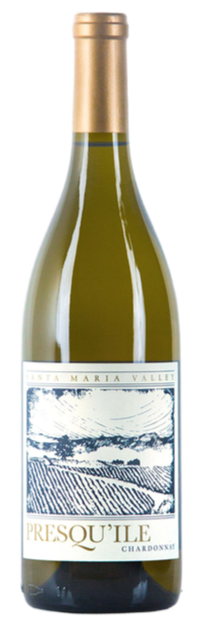
Let’s begin somewhere that might challenge the picture many of us have of California Chardonnay.
Santa Maria Valley sits close to the Pacific, and the cool maritime influence is a defining part of the wines Presqu’ile makes there. The winery describes its Chardonnay as a cool-climate expression of the estate, with white peach, apple, toast and salty sea air, built around texture and freshness rather than sheer richness.
The 2022 Estate Chardonnay is 100% Chardonnay, organically and sustainably farmed, fermented with native yeast and aged for 11 months, predominantly in Stockinger oak with a smaller proportion of French oak. It comes in at just 12.5% alcohol — another useful clue that this isn’t trying to be a caricature of California Chardonnay. And the critical response backs up that impression.
But, as you’re likely to know, I care a lot less about how many points a wine has and a lot more about what it actually has to say. So let’s not approach this as “California Chardonnay” in the abstract. Let’s treat it as a particular place.
A vineyard sitting under Pacific influence.
A family winery that began in 2007 after the Murphy family moved west following the loss of their Mississippi Gulf Coast home to Hurricane Katrina.
The name Presqu’ile — pronounced roughly press-keel — comes from that place. In French and Creole it means “almost an island”, and the winery was named for the family gathering place they lost. The California estate became a new expression of the same idea: somewhere to gather, share food and wine, and have a good time. Today the estate is run by the second generation, Matt and Anna Murphy, alongside winemaker Dieter Cronje.
There is something rather lovely about that.
A wine whose identity began with a place that no longer exists, now expressing a completely different place on the other side of the country.
Perhaps place is not quite as simple as we think.
In the glass
Look for:
white peach · apple · lemon · toast · saline freshness · texture
But don’t turn that into a checklist.
Take a sip.
Then another.
Let it move around the glass.
Notice what arrives first, what comes afterwards, and what remains when the fruit has disappeared.
The Second Wine.
Georges Deschamps Organic Chablis 2022
Chablis, Burgundy, France
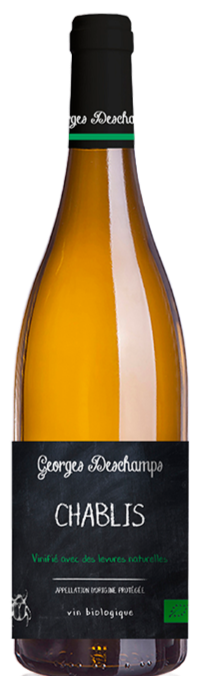
Now we cross the Atlantic and land in one of the most famous Chardonnay-growing places in the world.
Chablis.
And immediately, another set of expectations arrives with it. Chablis is supposed to be crisp. Mineral. Citrusy. Chalky. Perhaps even a little austere.
But Georges Deschamps offers a useful complication.
The wine is made by the Vrignaud family, whose roots in the area stretch back generations. Guillaume Vrignaud’s great-grandfather, Georges Deschamps, planted the family’s first vines in Premier Cru Fourchaume in 1955. The family now farms around 29 hectares, working organically and paying close attention to the different soil profiles of their parcels.
The Deschamps wines are deliberately a little different from the family’s classic range. They are bottled unfined and unfiltered, with the intention of retaining a richer aromatic profile and a more generous palate.
And that generosity is worth paying attention to.
So this isn’t necessarily the razor-sharp, almost austere Chablis that you may have encountered before.
It is still Chablis. But it’s Chablis with texture. Chablis with breadth. Chablis that reminds you that “mineral” does not have to mean thin, and “fresh” does not have to mean simple.
And there is the second surprise.
Because when you put the two glasses beside each other, the question isn’t really whether California or Burgundy makes better Chardonnay.
That would be far too easy.
The question is:
How much of what we call “Chardonnay” actually belongs to Chardonnay at all?
Try this.
Pour both wines before you read any more.
Don’t look at the bottles. Take a sip of each. Then ask yourself:
What did you expect?
Not what do you taste. Not which wine do you prefer. What did you expect to taste before you tasted it?
Perhaps one seems richer. Perhaps one seems sharper. Perhaps one tastes more obviously “French”. Perhaps neither does. Perhaps you prefer the wine you thought you wouldn’t.
There is no correct answer. That’s rather the point.
Now taste them again. This time, switch the order.
See what happens.
Two places. One grape.
It is tempting to think of wine as a collection of flavours.
Apple. Lemon. Peach. Butter. Toast. Stone. Salt.
But flavour is only part of the story.
Wine is also a record of decisions. Where the vines were planted. What the weather did that year. How the vineyard was farmed. When the grapes were picked. How they were fermented. What happened afterwards.
And, perhaps most importantly, what the winemaker decided not to do.
Presqu’ile and Deschamps start with the same grape, but they don’t start with the same place, and they certainly don’t finish with the same wine.
That is the magic of wine for me. It is simultaneously agricultural, geographical, historical and deeply human. A bottle can contain an enormous amount of information without ever becoming an exercise in expertise.
You don’t need to know the names of the soils or understand the chemistry. You don’t need to be able to identify twenty flavours blind.
You only need to notice.
And perhaps, every now and then, to be willing to be wrong.
The Last Experiment.
Before you decide which wine you prefer, try one last thing.
Go back to the beginning. Taste the wine you liked less. But this time, forget about whether you liked it.
Ask instead:
What is this wine trying to be?
Then ask:
What would I have missed if I had decided in advance that Chardonnay was supposed to taste a certain way?
That little shift — from judgement to curiosity — is what this first selection is really about.
Because changing your mind doesn’t mean you were foolish to have had an opinion in the first place. It means you allowed the world to give you new information.
And that is a surprisingly useful habit.
A Final Thought.
I don’t think we should spend our lives trying to avoid being wrong.
That would be exhausting. And, more importantly, it would make the world rather dull. I’d much rather be occasionally surprised. I’d rather discover that something I thought I understood has another layer to it. I’d rather have a wine in my glass that makes me stop and think:
Oh.
I wasn’t expecting that.
Because for a moment, the world has become interesting again.
And perhaps that is what curiosity really is. Not knowing less. Not knowing nothing.
Simply being willing to discover that there might be more to know.
Here’s to changing your mind.
The Wines.
Presqu’ile Estate Chardonnay 2022
Santa Maria Valley, California
100% Chardonnay · 12.5% ABV · organically and sustainably farmed
Georges Deschamps Organic Chablis 2022
Chablis, Burgundy, France
100% Chardonnay · organically certified
Two places.
One grape.
One question.
What did you think Chardonnay was?
